










We conduct independent research into significant challenges to the economy, society and the welfare state in a global world.
Become part of our research team
Research
The ROCKWOOL Foundation Berlin Institute for the Economy and the Future of Work (RFBerlin) engages in research designed to raise the standard of public debate and create the best possible basis for policy making.
Discussion papers
No. 136/26 - May 2026
Gender Representation and Collective Decision-Making in Expert Committees
Rigissa Megalokonomou
No. 135/26 - May 2026
The seniority ceiling: Why some immigrants struggle to rise in political office
Olle Folke, Johanna Rickne
No. 134/26 - May 2026
Revealing Life Preferences Through LLMs
Omar Abdel Haq, Amitabh Chandra, Tomáš Jagelka, Erzo F.P. Luttmer, Joshua Schwartzstein
No. 133/26 - May 2026
The Demand for Private Schools and Its Impact on School Segregation and Student Outcomes
Jacob Arendt, Anders Holm
Research Insights
Concise, research-based articles for scholars,
policymakers, and anyone curious about the world.

No. 16/26 - May 2026
When Checklists Backfire: Too Much Control Can Harm Workers and Sales
The quality of management practices is crucial for both productivity of firms and the wellbeing of workers. Many firms use checklists as a management practice. Top managers often believe in the benefits of checklists as a mechanism to assure product and service quality. But what about workers?
Learn more
No. 15/26 - May 2026
How Parents Divide Parental Leave: The Roles of Culture Versus Economic Incentives
Fathers in Sweden, as elsewhere, take less parental leave than mothers. Several countries have tried to generate incentives to increase men’s share of leave. Evidence from Sweden suggests the answer lies in the cultural change that occurs in response to changing incentives.
Learn more
No. 14/26 - April 2026
When Far-Right Protests Get More Attention, Hate Crimes Rise
What happens after a far-right protest ends? The effects do not stop when the crowd goes home. Visibility of far-right protest matters for the onset of politically motivated violence.
Learn moreCReAM Reports
Data-driven reports on migration and related economic and social trends, highlighting the latest developments across Europe and beyond.

No. 3/26 - April 2026
The Immigrant Population in the European Union: Growth, Concentration and Dispersion
The EU hosts a record 64 million foreign-born residents, with migration continuing to grow strongly, though unevenly across countries. While Germany and Spain dominate in absolute numbers, smaller Member States often face greater relative pressure.
View report
No. 2/26 - March 2026
Migration Aspirations, Diaspora Networks and Refugee Destinations from Iran and Lebanon
Migration from Iran and Lebanon largely follows existing diaspora routes, especially to Germany and Canada. If displacement rises, flows will likely concentrate in a few high-income countries, with education shaping how widely destinations are considered.
View report
No. 1/26 - February 2026
Four Years On: What Gallup Data Reveal About Staying, Leaving, and Life Expectations in Ukraine
Migration aspirations in Ukraine fell sharply after 2022, dropping from about one-third of adults pre-war to under 15% by 2023–2024. The decline is widespread, likely reflecting stronger attachment and recovery optimism, with Germany still the top destination among those who wish to leave.
View reportNews
RFBerlin research and researchers are regularly featured in the press.


27 Apr 2026
CReAM at RFBerlin Director Tommaso Frattini Discusses Latest Migration Trends on Rai Radio 1
View article
22 Apr 2026
CReAM Report on Immigrant Population in the EU Featured in Global Media Outlets
View article
Tweets by @RF_Berlin
Apply to join the masterclass by Alexandre Mas. Deadline is today!
👉 Form: https://form.typeform.com/to/C1nGx934
🔗 Event details: https://www.rfberlin.com/event/masterclass-mas/
Get a comprehensive overview through the analysis of revealed-preference methods for non-wage amenities in the workplace.
#EconPhD
And it’s a wrap! Two inspiring days at the @RF_Berlin Handbook Masterclass on “Labor Force Transitions” with @mposchke and Fabian Lange.
A fantastic combination of rigorous academic work and insightful research discussions brought together early-career scholars and leading
🧠New RFBerlin Research Insight!
Policy sets the spark. Culture does the heavy lifting.
New research on Sweden’s parental leave reforms: the extra “daddy month” directly explained only 8.8% of fathers taking more leave. The biggest driver? Social norms. As more dads took
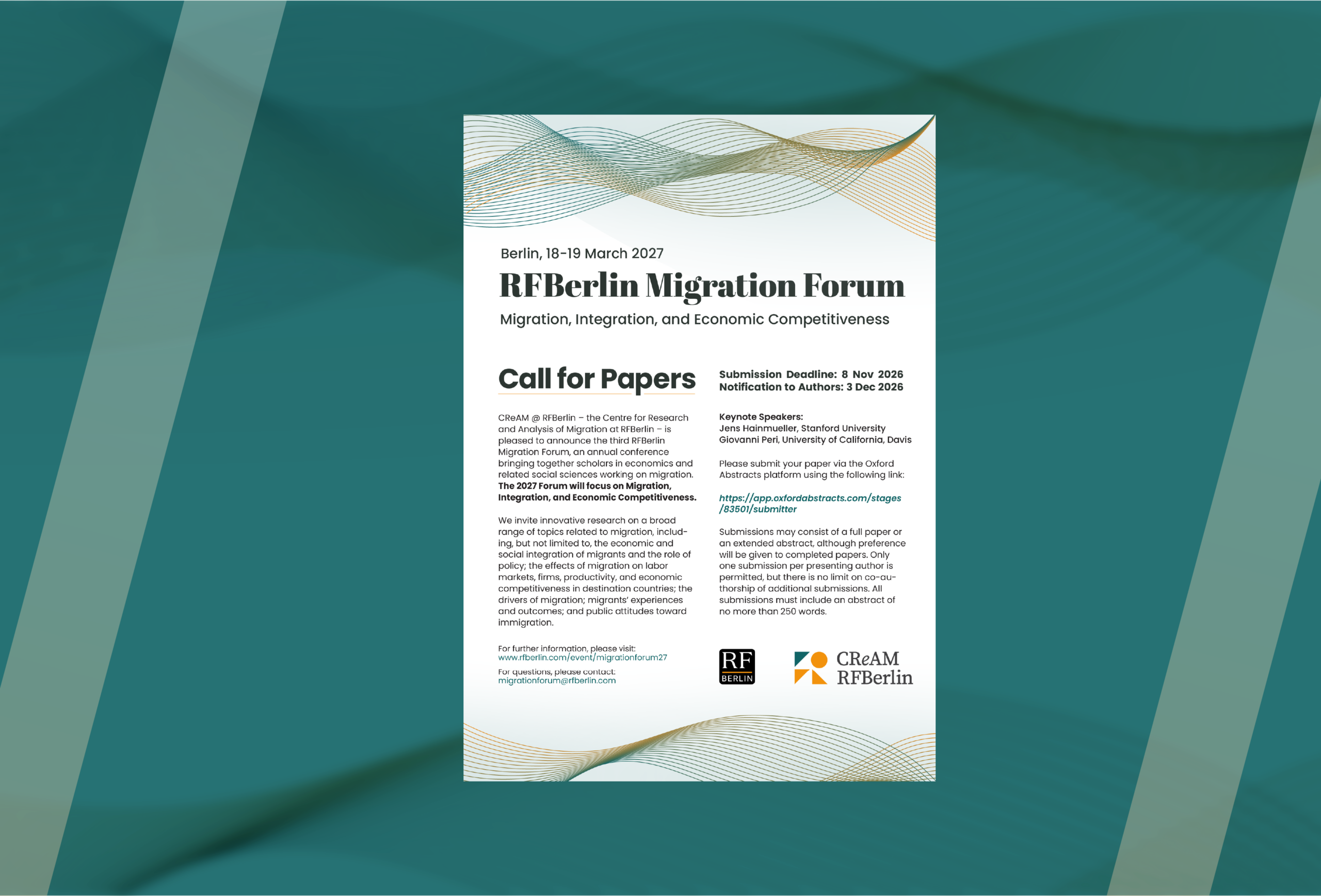
Upcoming events
RFBerlin hosts a wide array of events aimed at fostering academic research and collaboration.
RFBerlin Applied Economics Seminar
14 May 2026
Torben Nielsen (University of Copenhagen)
Event Cancelled
RFBerlin Applied Economics Seminar
20 May 2026
Jacob Moscona (MIT)
Public R&D Meets Economic Development: Embrapa and Brazil’s Agricultural Revolution
Handbook of Labor Economics – Chapter Previews
In anticipation of the upcoming Handbook of Labor Economics, we offer early access to select chapters through our Discussion Papers series. Following our 2023 conference on this new edition, first chapters are now available for preview, featuring insights from leading research in economics and labor.

Sign up to our newsletter
Keep up to date with upcoming RFBerlin events, our new research and other news from our research centre.